Rolling Steel Doors: What They Are and How They Work
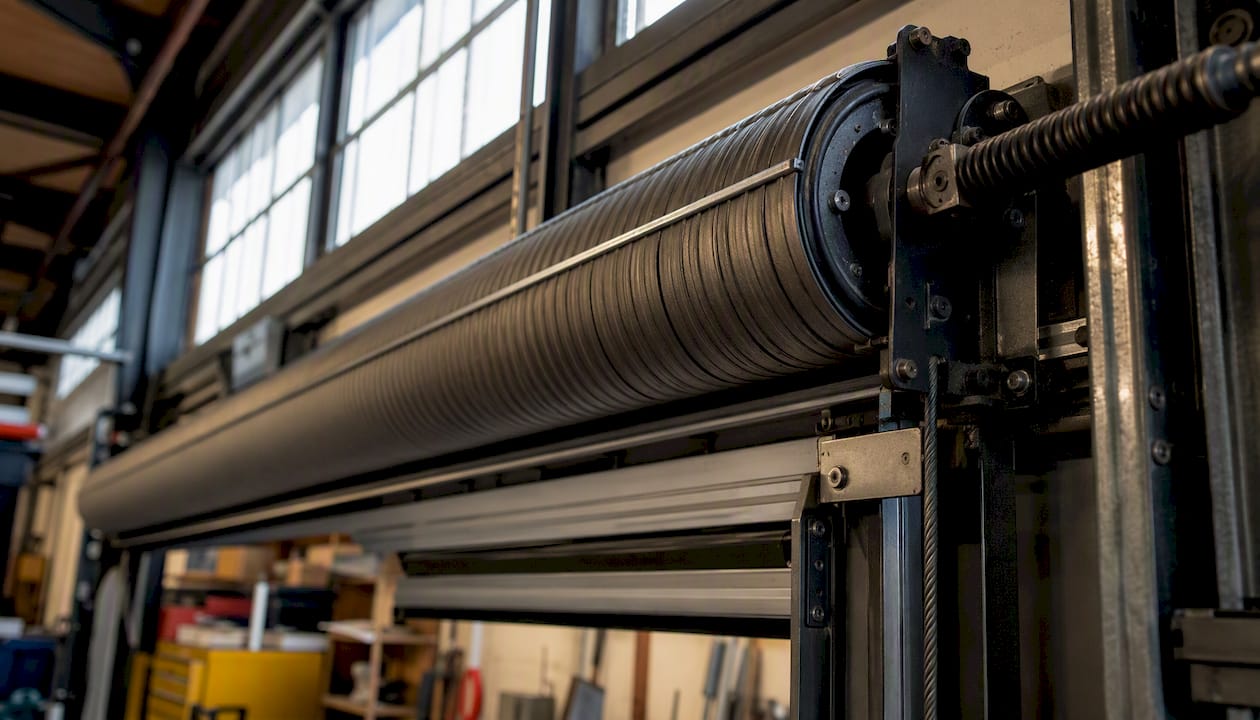
A rolling steel door is a vertically operating coiling door made from interlocking steel slats that roll into a compact barrel mounted at the header of the opening. It’s the go-to choice when you need high security, a long cycle life, or minimal headroom clearance above the door. You can spot one in the field by three things: a slatted curtain (not a flat sheet or hinged panels), a tight coil sitting above the opening, and heavy-duty vertical guides on each side.
Quick identifiers at a glance:
- Slatted curtain: Rows of interlocking steel slats, not a single corrugated sheet or sectional panels
- Compact coil: The door rolls into a barrel at the header, keeping ceiling space clear
- Heavy guides: Thick vertical tracks on each jamb that the curtain travels in
- Bottom bar: A reinforced steel bar at the base of the curtain, often carrying the sensing edge or astragal seal
If your opening sees heavy daily traffic, stores high-value inventory, or has limited overhead clearance, a rolling steel door is almost certainly the right call.
Key Takeaways
A rolling steel door is the correct commercial choice when cycle demand, security, or limited headroom rules out sectional and sheet-door alternatives — and the spec sheet must match the actual duty cycle before any other feature matters.
| Point | Details |
|---|---|
| Core definition | Interlocking steel slats coil into a barrel at the header; not a sheet door or sectional panel door. |
| Spec by cycle demand first | Cycle rating and gauge (18/20/22) must match actual daily use before adding insulation or fire features. |
| Size range | Custom-built doors reach roughly 40 feet wide and 30 feet high for large industrial openings. |
| Maintenance reality | Monthly sensing-edge tests and quarterly lubrication protect the spring and operator; annual professional inspection is non-negotiable. |
| Mikes garage doors Loveland colorado | Provides commercial rolling steel door installation, inspection, and same-day repair across Northern Colorado. |
Table of Contents
- What is a rolling steel door, exactly?
- How do rolling steel doors work?
- What types of rolling steel doors are available?
- How does a rolling steel door compare to other commercial door types?
- Where are rolling steel doors typically used?
- What are the real advantages and limitations?
- What specs and materials should you look for?
- What operators and accessories do commercial rolling steel doors need?
- How do you maintain a rolling steel door?
- How do you choose the right rolling steel door?
- What does industry guidance say about selecting rolling steel doors?
- What our technicians see in the field
- Rolling steel door service in Northern Colorado
- Sources
- FAQ
What is a rolling steel door, exactly?
The industry term is rolling service door or rolling steel door, and it refers specifically to a coiling curtain assembly, not a sheet door or a sectional overhead door. According to Alpine Overhead Doors, the core components are the curtain, bottom bar, pipeshaft and bracket plates, guides, hood, and operator. Each part has a defined job.
Primary components
- Curtain/slats: Interlocking steel slats that flex as they coil. Each slat profile is engineered to lock into the one above and below, keeping the curtain rigid when closed.
- End locks/windlocks: Hardware at the slat ends that engages the guides and resists lateral separation under wind pressure or forced entry.
- Bottom bar: The weighted steel bar at the curtain’s base. It carries seals, sensing edges, and provides the closing force.
- Pipeshaft (barrel): The horizontal steel pipe around which the curtain coils. Bracket plates anchor it to the wall or structural header.
- Guides: Vertical channels on each side of the opening. The curtain travels inside them and they hold the door in plane when closed.
- Hood: The metal enclosure that covers the coiled curtain and barrel assembly. It protects the coil from dust, debris, and weather.
- Operator or spring assembly: Either a motorized operator or a torsion spring system that counterbalances the curtain weight and drives the door open and closed.
A short glossary you’ll see on spec sheets: curtain gauge refers to the steel thickness of the slats; cycle rating is the number of open/close operations the door is rated for; wind pressure rating is the lateral load the closed curtain can resist; fire rating indicates compliance with fire-door standards for protected openings.
How do rolling steel doors work?
When you trigger the door to open, the operator or spring assembly lifts the curtain. The slats travel up through the guides and coil around the barrel, wrapping tightly into a compact cylinder. When the door closes, the curtain uncoils and descends back through the guides until the bottom bar contacts the floor or threshold.
Manual vs. motorized operation
Spring-assisted manual doors use a torsion spring mounted on the pipeshaft to counterbalance the curtain weight. A pull chain or hand crank lets one person operate a door that might weigh several hundred pounds. These are common in low-cycle applications like storage rooms or secondary access points.
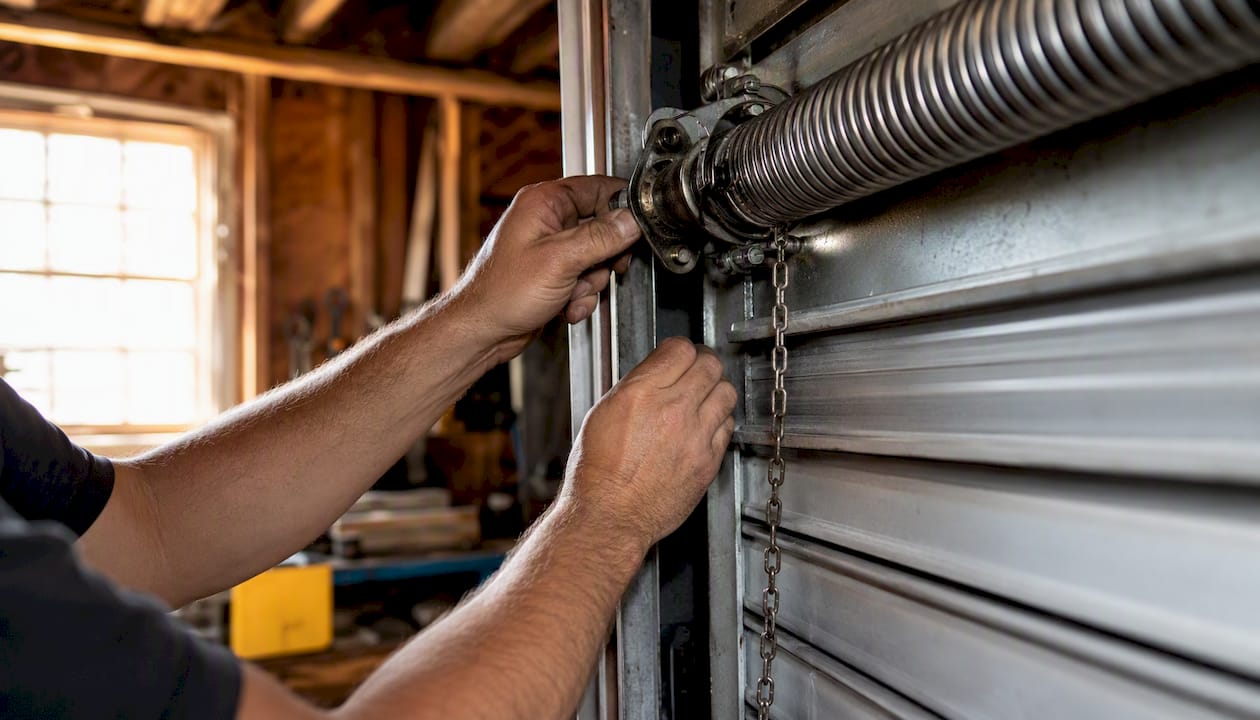
Motorized operators range from standard gear-reduced chain-drive units to high-cycle direct-drive motors built for thousands of operations per day. Direct-drive units are quieter, faster, and require less maintenance than chain-drive models, making them the right call for loading docks or any opening that cycles more than 20–25 times per day.
Safety devices
- Sensing edge: A pressure-sensitive strip on the bottom bar that reverses the door if it contacts an obstruction
- Limit switches: Set the open and closed stop positions for the operator
- Inertia brake: Stops the curtain from free-falling if the drive fails
- Emergency chain/crank: Allows manual operation during a power outage
Pro Tip: If the door hesitates at the same point every cycle, that’s usually a guide alignment or curtain-binding issue. If it runs smoothly but the operator sounds strained, suspect a spring that’s lost tension. Those two failure modes point to completely different repairs.
What types of rolling steel doors are available?
DASMA’s Spring 2024 guidance organizes rolling doors into several families, each suited to a different set of demands. Knowing which type you need before you call a supplier saves a lot of back-and-forth.
- Standard service (slat) doors: The most common type. Available in 18, 20, and 22 gauge steel. Used in warehouses, loading docks, and commercial facilities where durability and security matter more than insulation.
- Insulated slat doors: Slats filled with polystyrene or polyurethane foam for thermal control. The right pick for temperature-controlled spaces, coolers, or any opening where conditioned air loss is a real cost.
- Sound-rated doors: Insulated slats with additional acoustic treatment. Useful in manufacturing facilities where noise separation between zones is required.
- Rolling grilles and perforated slats: Open-pattern curtains that allow visibility and airflow while still providing a physical security barrier. Common in retail storefronts, parking garages, and counter applications.
- Fire-rated rolling steel doors: Built to UL 10B or UL 10C standards and fitted with automatic-release fusible links or electromagnetic hold-opens that drop the door closed when a fire alarm triggers. Required in fire-rated wall assemblies.
- Wind-load rated doors: Reinforced with heavier gauges, additional windlocks, and sometimes internal bracing to meet local building code wind-pressure requirements. Critical in coastal or high-wind regions.
- High-cycle/high-speed variants: Engineered for extreme duty cycles, often rated for 100,000 or more operations. High-speed rolling steel doors also reduce energy loss at high-traffic openings by minimizing the time the door stays open.
How does a rolling steel door compare to other commercial door types?
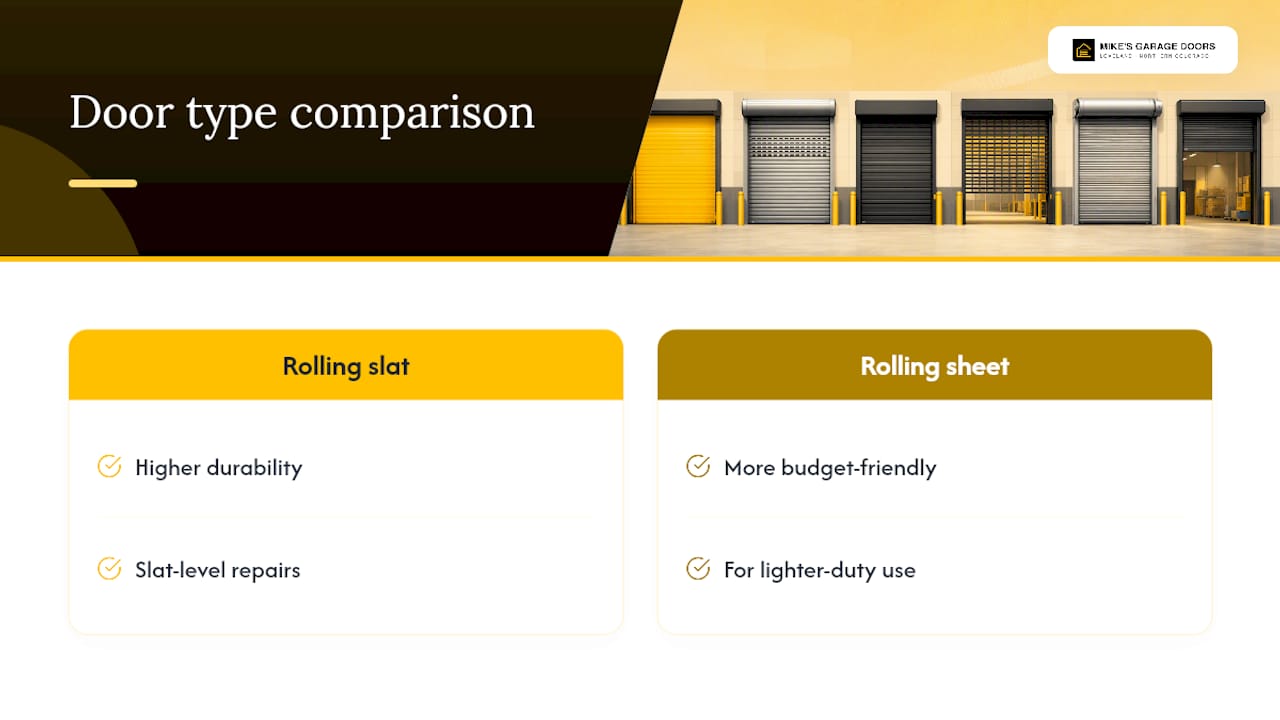
The three types you’ll most often weigh against each other are rolling steel (slat) doors, rolling sheet doors, and sectional overhead doors. Janus International’s comparison puts it plainly: slat doors offer higher durability and easier slat-level repairs, while sheet doors are more budget-friendly for lighter-duty use.
Construction differences
Rolling steel (slat) doors use many interlocking slats. If one slat bends or cracks, you replace that slat, not the whole curtain. Gauges run from 22 (lighter commercial) down to 18 (heavy industrial), and General Door Service notes that windlocks and end locks at the slat ends increase lateral rigidity and wind resistance.
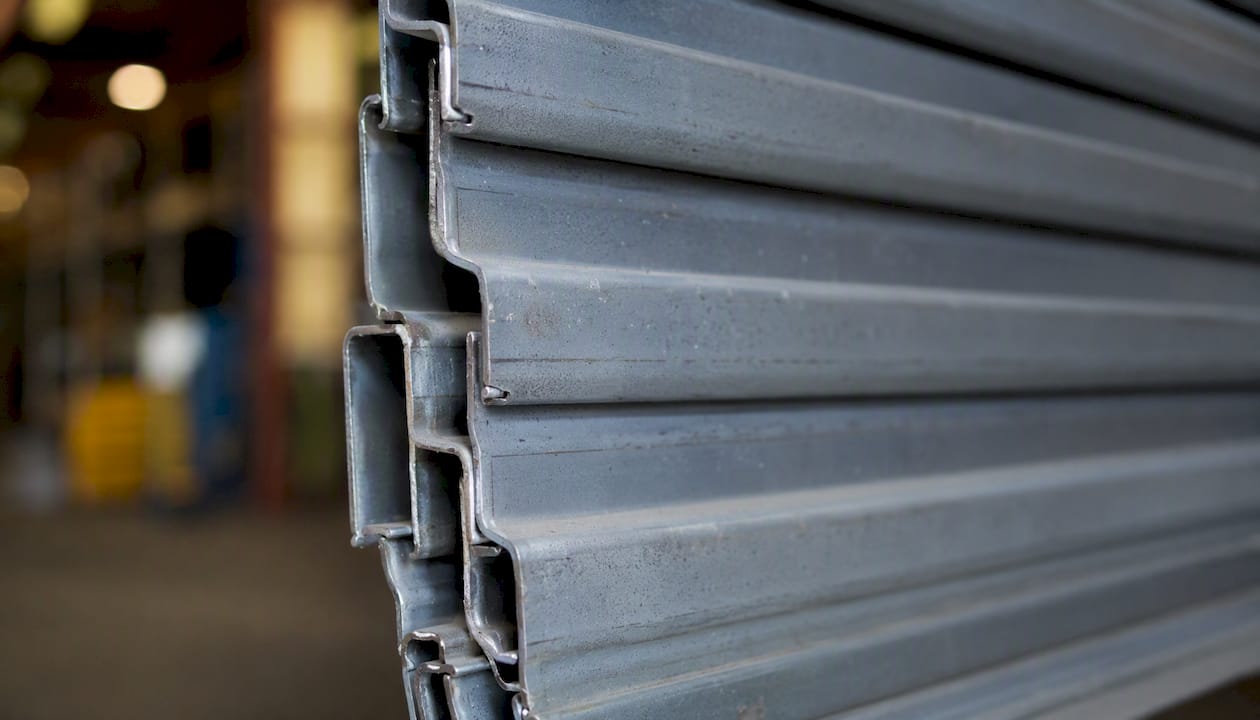
Rolling sheet doors are a single corrugated steel sheet that coils around a barrel. They’re lighter, faster to install, and cost less upfront. The trade-off: a dent or tear means replacing the entire sheet, and they’re not rated for the same cycle counts as slat doors.
Sectional overhead doors use hinged horizontal panels that travel up a curved track into the ceiling. They insulate well and handle large openings cleanly, but they need significant headroom and horizontal track space. A rolling steel door coils into a compact barrel, freeing that ceiling space for sprinklers, ductwork, lighting, or storage racks — a real advantage in high-bay industrial buildings.
Choosing between them
- High cycles, high security, or limited headroom: rolling steel slat door
- Budget-conscious, low-cycle, light commercial: rolling sheet door
- Large openings needing strong insulation and you have the headroom: sectional overhead door
Where are rolling steel doors typically used?
DASMA’s application guidance lists warehouses, loading docks, parking garages, aircraft hangars, and storefront counters as the primary placements. The deciding factor in each case is usually a combination of cycle demand, security requirement, and available headroom.
- Warehouses and distribution centers: High daily cycle counts and the need to secure large openings overnight make rolling steel the standard choice.
- Loading docks: Dock doors take a beating. The slat construction handles repeated forklift-adjacent traffic and the occasional impact better than a sheet door.
- Parking garages: Rolling grilles or solid slat doors control access at entry/exit points while keeping the structure open to airflow.
- Aircraft hangars: Large custom-built rolling doors handle wide openings where sectional doors would require impractical track runs.
- Retail storefronts and counters: Rolling grilles let light and air through after hours while keeping the space physically secured. They also serve as interior security barriers between departments.
- Fire-rated corridor and stairwell openings: Fire-rated rolling steel doors provide the required separation in commercial buildings without consuming floor space.
What are the real advantages and limitations?
Advantages
- Security: A closed rolling steel curtain is significantly harder to breach than a sectional panel door. The interlocking slat design and guide engagement resist prying and forced entry.
- Compact coil: The door stores entirely above the opening. No horizontal track, no ceiling-mounted sections — ceiling space stays clear.
- High-cycle durability: Properly specified and maintained, a rolling steel door handles far more daily cycles than most sectional alternatives.
- Repairability: Individual slats can be replaced without pulling the whole curtain. That keeps repair costs lower over the door’s life.
- Custom sizing: Janus International confirms these doors can be custom-built for openings up to roughly 40 feet wide and 30 feet high.
Limitations
- Noise: Steel slats on steel guides are louder than insulated sectional doors. High-cycle facilities often accept this; noise-sensitive environments may not.
- Weight: A heavy-gauge curtain is not light. Spring and operator sizing must match the curtain weight precisely, or you’ll wear out the drive system fast.
- Insulation limits: Standard slat doors have poor thermal performance. Insulated slat options exist but add cost and reduce the cycle rating slightly.
- Upfront cost: Rolling steel doors cost more than sheet doors. The lifecycle math usually favors them in high-cycle applications, but the initial spend is higher.
Pro Tip: If noise is a concern, ask for nylon guide inserts and a rubber astragal on the bottom bar. If insulation is the issue, specify polyurethane-filled slats rather than polystyrene — the R-value difference is meaningful in a refrigerated space.
What specs and materials should you look for?
Steel gauge is the starting point. Lighter 22-gauge slats work for low-cycle commercial applications; 20-gauge is the standard for most warehouse and dock doors; 18-gauge is the pick for high-security or heavy industrial use. General Door Service’s breakdown explains that windlocks and end locks at the slat ends engage the guides to resist lateral separation, which matters both for wind resistance and forced-entry protection.
Finish options include galvanized steel (best corrosion resistance for exterior or high-humidity environments), painted galvanized (adds color and a second corrosion barrier), and bare cold-rolled steel (interior use only). For coastal or high-humidity sites, galvanized is not optional.
Wind-load ratings follow local building codes. If your jurisdiction requires a specific wind-pressure rating, confirm the door’s tested pressure rating on the spec sheet, not just the manufacturer’s marketing language. Building code assembly references specify guide and assembly requirements for rolling doors in protected openings, and your local AHJ (Authority Having Jurisdiction) will check compliance.
Key spec-sheet items to read before signing a purchase order:
- Curtain gauge: Thicker is more durable and more expensive
- Cycle rating: Matches your expected daily use over the door’s intended life
- Wind pressure rating: Expressed in pounds per square foot; must meet local code
- Fire rating: UL 10B (non-labeled) or UL 10C (labeled) for fire-rated openings
- Insulation value (R-value): Only relevant for insulated slat doors; confirm the fill material
For a deeper look at how insulation, fire rating, and wind-load options interact, the commercial garage door features guide walks through each option clearly.
What operators and accessories do commercial rolling steel doors need?
The operator is what makes a motorized rolling steel door practical. Three main types cover most commercial applications:
- Gear-reduced chain-drive operators: Reliable and cost-effective for moderate-cycle applications (up to roughly 20 cycles per day). Louder than direct-drive units but proven in the field.
- Torsion spring systems (manual): No motor, no power requirement. The spring counterbalances the curtain weight so one person can operate the door by hand. Best for secondary access points or backup operation.
- Direct-drive high-cycle motors: Quieter, faster, and built for heavy daily use. The right choice for loading docks, parking garage entries, or any opening that runs all day.
Controls and accessories
- Keypads and card readers: Control access without distributing physical keys
- Loop detectors: Embedded in the floor to detect vehicles and trigger automatic opening
- BMS integration: Connects the door to a building management system for centralized monitoring and scheduling
- Slide locks and security boxes: Mechanical locking when the door is closed and the operator is off
- Weather seals: Brush seals on the guides and a rubber astragal on the bottom bar reduce air infiltration and debris entry
- Sensing edge: Required on most powered commercial doors; reverses the door on contact with an obstruction
How do you maintain a rolling steel door?
Routine maintenance is what separates a door that lasts 20 years from one that needs a major repair in five. Janus International’s maintenance guidance identifies springs and operators as the most common wear points, alongside curtain lubrication.
Scheduled inspection checklist
- Monthly: Visually inspect the curtain for bent, cracked, or missing slats. Check that the bottom bar seal contacts the floor evenly across the full width.
- Monthly: Test the sensing edge by placing a 2x4 flat on the floor under the closing door. The door must reverse on contact.
- Quarterly: Lubricate the guides, barrel bearings, and spring shaft with a lithium-based grease. Do not use WD-40 on springs — it strips existing lubrication.
- Quarterly: Check limit switch settings. The door should stop cleanly at full open and full closed without coasting or bouncing.
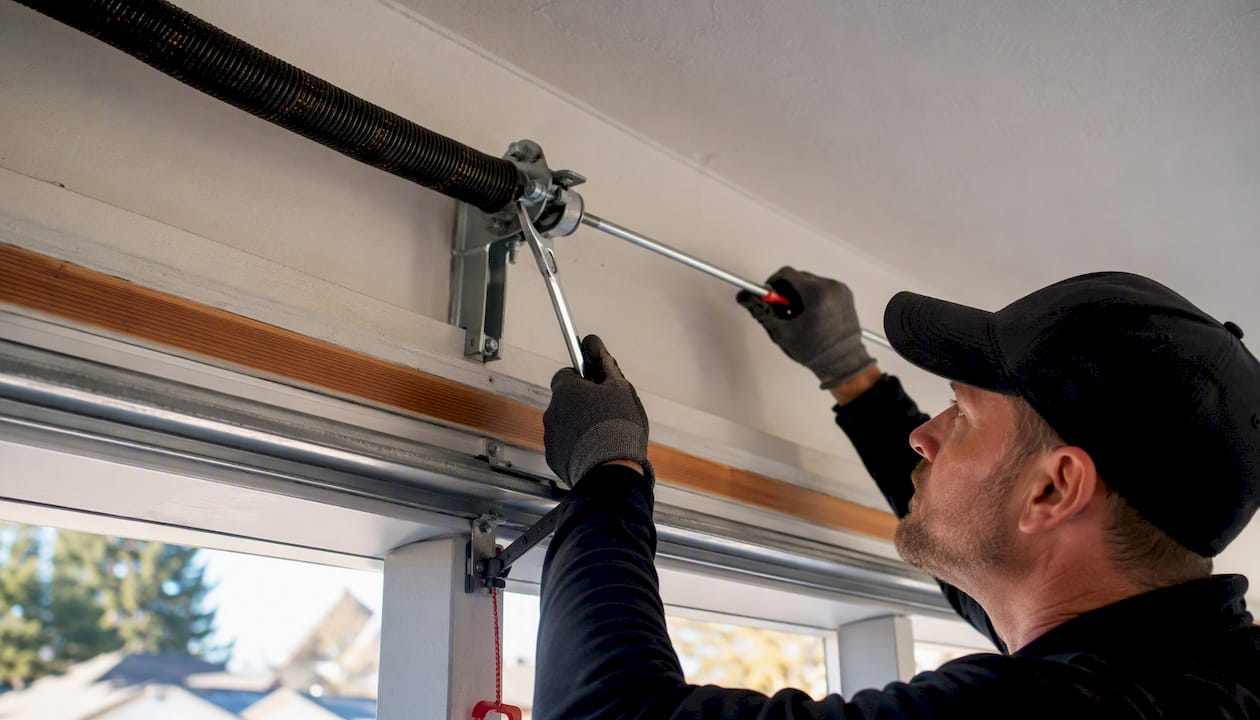
- Annually: Have a technician inspect spring tension, operator drive components, and guide alignment. Springs under tension are dangerous to adjust without the right tools.
- Annually: Check windlock engagement. Each windlock should slide freely in the guide without binding.
Common repair signals: uneven travel (one side of the curtain leads the other) points to guide misalignment or a broken windlock; grinding from the barrel area usually means a bearing is failing; operator strain on a door that ran fine last month often means a spring has lost tension.
A light-duty door (under 10 cycles per day) realistically lasts 15–20 years with proper maintenance. A high-cycle dock door running 50+ cycles per day may need spring and operator service every 3–5 years, though the curtain itself can last much longer. For a structured maintenance schedule, the commercial garage door maintenance guide lays out service intervals by usage intensity.
How do you choose the right rolling steel door?
Start with use case, not aesthetics. Cycle demand and security requirements drive every other decision. Here’s the order to work through:
- Step 1 — Cycle demand: Estimate daily open/close cycles. Under 10: standard service door. 10–50: specify a higher cycle-rated operator and 20-gauge curtain. Over 50: high-cycle direct-drive operator and 18-gauge curtain minimum.
- Step 2 — Headroom: Measure the space between the top of the opening and the ceiling. Rolling steel doors need roughly 12–18 inches of headroom for the coil and hood, depending on curtain weight and barrel diameter.
- Step 3 — Insulation and fire/wind needs: Does the opening separate conditioned from unconditioned space? Is it in a fire-rated wall? Does local code require a wind-pressure rating? Each yes adds a spec requirement.
- Step 4 — Operator type: Match the operator to the cycle demand and access-control requirements.
- Step 5 — Budget vs. lifecycle cost: A heavier-gauge door with a direct-drive operator costs more upfront but typically costs less over 10 years in a high-cycle application.
Questions to ask your supplier or installer
- What is the cycle rating of this specific curtain-and-operator combination?
- What is the lead time, and does it change if I add fire rating or custom sizing?
- Who handles field repairs — the manufacturer, a local distributor, or a third-party service company?
- What does the warranty cover, and for how long?
- Is the door tested and labeled for the wind-pressure rating my local code requires?
Lead time for a standard rolling steel door runs 2–4 weeks. Fire-rated, custom-sized, or insulated doors often run 4–8 weeks. Factor that into your project schedule before you commit to an installation date.
What does industry guidance say about selecting rolling steel doors?
DASMA’s TDS-277 technical data sheet provides the industry-standard definitions for rolling door terms and assembly components. The core selection principle from DASMA’s guidance is straightforward:
Manufacturer guidance consistently reinforces this: rolling steel doors can be customized for wind-load, fire rating, and insulation, but those features are layered onto a correctly specified base door. Getting the gauge and cycle rating right first is what makes everything else work. For technical definitions and assembly component guidance, DASMA’s published standards are the authoritative reference — not marketing brochures.
What our technicians see in the field
The most common mistake we see is under-specifying the door for the actual cycle demand. A property manager estimates “maybe 10 times a day” and orders a standard-grade door. Six months later, the operator is straining and the spring tension is off because the real cycle count was closer to 40. That gap between estimated and actual use is where most premature failures start.
Before you call a technician or request a quote, gather four pieces of information: the exact opening dimensions (width and height to the nearest quarter inch), your realistic daily cycle count, whether the opening is in a fire-rated wall, and your local wind-pressure code requirement. With those four numbers, a qualified installer can spec the right door in one conversation instead of three.
The diagnostic inspection guide is a good starting point if you want to understand what a technician checks during a site visit before you schedule one.
Rolling steel door service in Northern Colorado
Mikes garage doors Loveland colorado handles commercial rolling steel door inspections, installations, maintenance visits, and emergency repairs across Northern Colorado.
If you’re trying to spec a new door, troubleshoot an existing one, or just need a professional set of eyes on a curtain that’s been running rough, the right next step is a quick call. Visit the garage door services page to see the full range of commercial services and request a quote or same-day inspection.
Sources
The following primary sources are worth bookmarking if you’re comparing quotes or verifying ratings:
- Rolling doors 101: Anatomy, styles and applications — DASMA (Spring 2024)
- Slat vs. sheet: How to choose the right overhead door — Janus International
- Rolling doors 101: Anatomy, styles, and applications — Alpine Overhead Doors
- Up
- Rolling steel doors or steel sheet doors? What’s the difference? — General Door Service
FAQ
How do rolling steel doors work?
The curtain travels up through vertical guides and coils around a barrel mounted at the header; a motorized operator or torsion spring counterbalances the curtain weight and drives the movement. Safety devices including a sensing edge and inertia brake protect against obstruction and free-fall.
What is the difference between rolling and sectional steel doors?
Rolling steel doors coil into a compact barrel above the opening, requiring minimal headroom and no horizontal track. Sectional doors use hinged panels that travel up a curved track into the ceiling, offering better insulation but consuming significantly more overhead and ceiling space.
What does “rolling door” mean in commercial construction?
A rolling door is a vertically operating coiling door, typically made from interlocking steel slats, used in commercial or industrial openings where security, high cycle life, or limited headroom is a priority. DASMA’s technical standards define it as a coiling door assembly distinct from sheet doors and sectional doors.
What are metal rolling doors called?
The industry terms are rolling service door, rolling steel door, or coiling door. Rolling grilles (open-pattern curtains) and rolling sheet doors (single corrugated sheet) are related but distinct products within the broader rolling door family.
Recommended
Need a hand with your door?
Talk to a real tech — most calls are diagnosed in under two minutes.