Commercial Dock Door Function Explained for Facility Managers
A commercial dock door does three things: it controls truck-level access, seals the building envelope against energy loss, and creates the safety boundary that keeps workers and equipment from a 48-inch fall to grade. When it works, you barely notice it. When it doesn’t, every bay it serves goes offline.
The operational stakes are real:
- Throughput: A slow or stuck door creates a bottleneck that backs up the entire loading sequence, from restraint engagement to leveler deployment.
- Energy costs: Insulated dock doors with tight weather seals can reduce energy loss by roughly 20–30% in loading-dock exchange scenarios.
- Worker safety: OSHA treats an open dock opening as an unprotected fall hazard regardless of whether active work is happening, requiring guardrails, self-closing gates, or other engineered barriers.
Dock doors are also the most overlooked high-traffic asset in a facility, even though their condition directly drives energy spend and throughput predictability.
Table of Contents
- How does a commercial dock door actually function?
- Which dock door type fits your operation?
- What safety features must your dock door have?
- How dock doors connect with the rest of your loading system
- Maintenance intervals, lifespan, and repair timelines
- Warning signs and when to call a technician
- Key Takeaways
- What a dock door technician actually finds on the first visit
- Fast, honest commercial door service in Northern Colorado
- Useful sources
- FAQ
How does a commercial dock door actually function?
The door’s function starts with its components. Each one affects a different dimension of performance: safety, cycle speed, or thermal control.
Panels and curtains
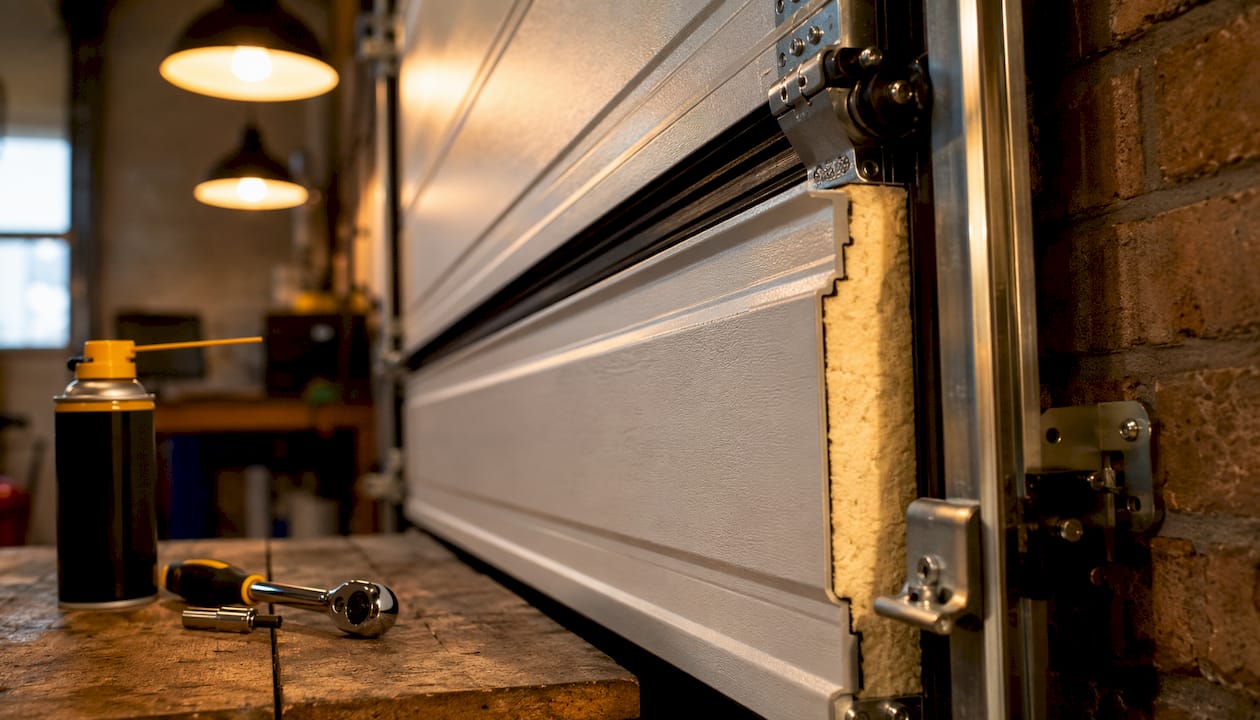
Sectional panels are typically steel or aluminum, often with a polyurethane foam core. The R-value of that core determines how much heat transfer the door resists. A door with R-16 or higher acts as a genuine thermal barrier; a bare steel panel offers almost none. High-speed doors use flexible fabric or rubber curtains instead, which prioritize cycle speed over insulation.
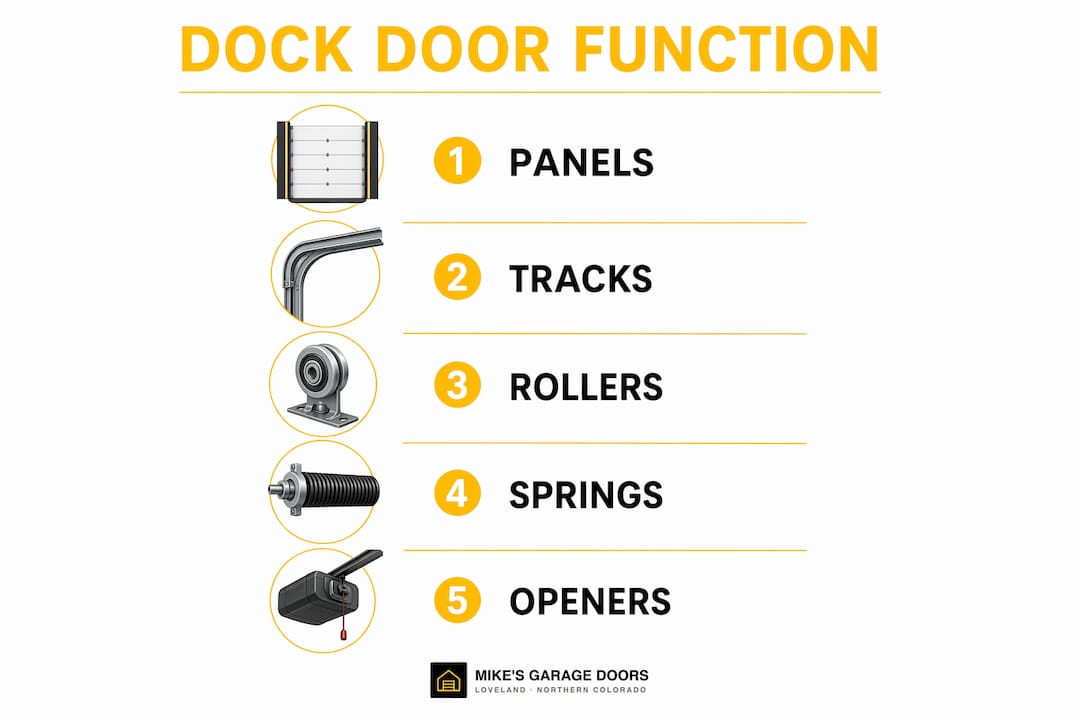
Tracks, rollers, and counterbalance springs
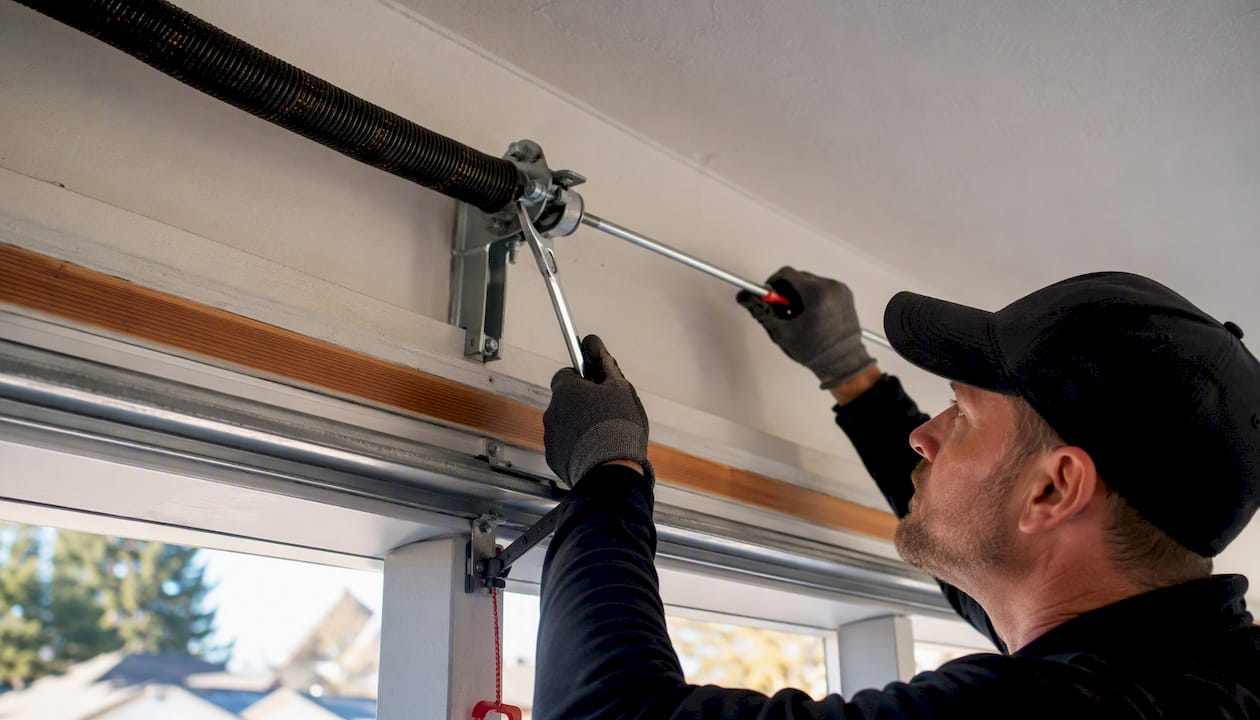
Tracks guide the door through its travel path. Rollers ride those tracks, and their wear condition determines whether the door moves smoothly or binds. The counterbalance spring system (usually torsion springs on commercial doors) offsets the door’s weight so the opener motor doesn’t carry the full load. A squeak or sluggish operation almost always traces back to spring fatigue, track misalignment, or worn rollers — and left alone, those problems escalate to full system failure.
Openers, controllers, and interlocks
Commercial openers are sized to the door’s weight and cycle count. Controllers manage sequencing: they can be programmed to prevent the door from opening until the vehicle restraint is engaged, which is the interlock function. Bypassed or malfunctioning interlocks defeat the entire safety design and are a common inspection failure point.
Safety sensors
Photo-eye sensors project a beam across the door opening. If anything breaks that beam during closing, the door stops and reverses. Pressure-sensitive edges do the same on contact. Industry guidance requires that auto-reverse functionality trigger within about 2 seconds of encountering resistance. A door that takes longer is non-compliant and creates serious injury risk.
Pro Tip: During a quick spot-check, run the door through one full cycle and watch for uneven travel, listen for grinding or popping, and time the close. Any of those three signals warrants a technician call before the next shift.
Which dock door type fits your operation?
Matching the door to the bay’s job is where most facilities leave money on the table. The DASMA technical guidance on dock doors identifies four main categories, each suited to a different set of demands.
- Sectional overhead doors: Hinged horizontal panels that roll up on ceiling tracks. Best for moderate-cycle bays where insulation matters, such as a refrigerated distribution center or a manufacturing plant with climate-controlled storage. They accept insulated cores and fit most standard headroom configurations.
- High-speed fabric doors: Open and close at several feet per second, minimizing air exchange between environments. The right choice for cold storage, food processing, and any bay where cycle count is high and temperature control is non-negotiable. Many models include self-repairing bottom bars that pop back into place after a minor impact.
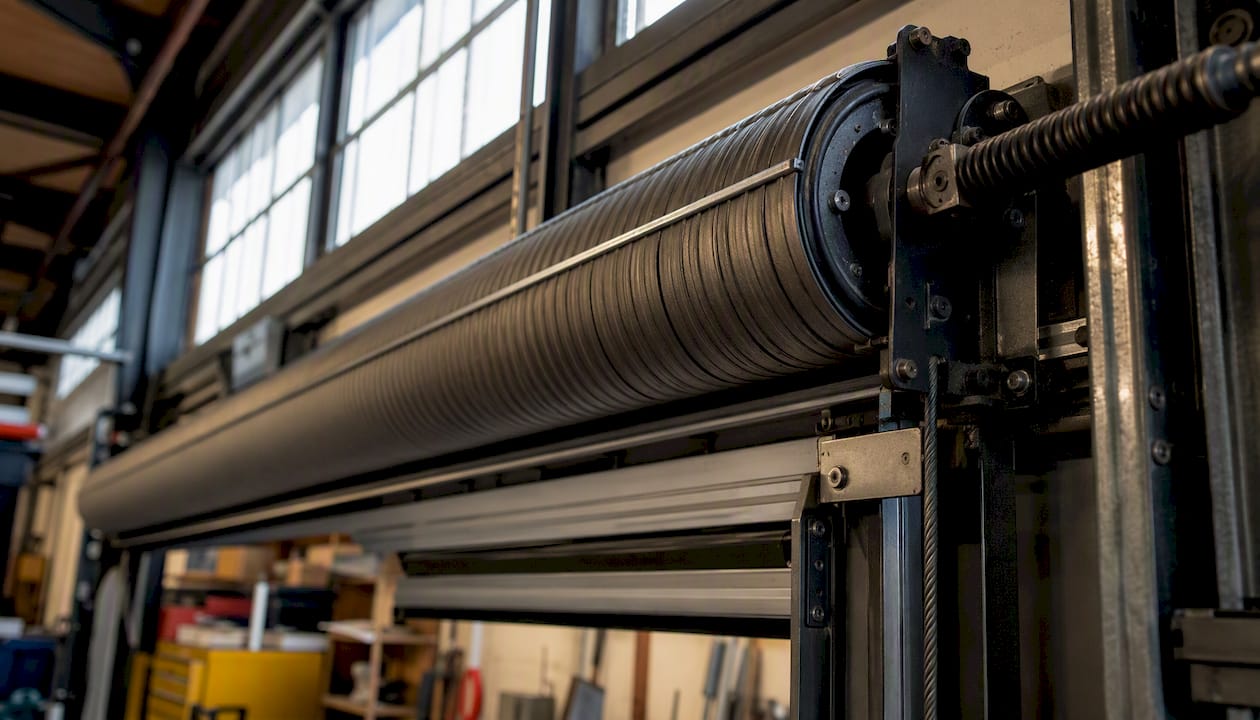
- Rolling steel (coil) doors: Steel slats coil into a compact drum above the opening. They offer the strongest resistance to forced entry and work well in tight-headroom bays or after-hours secure access points where security outweighs speed.
- Impactable / breakaway doors: Flexible panels or breakaway tracks that absorb forklift contact and self-reset or require minimal repair after a hit. For high-contact cross-dock bays, these doors reduce downtime far more than a rigid door that needs full track replacement after every strike.
High-traffic facilities often benefit from mixing door types across bays: high-speed doors for active receiving lanes, rolling steel for overnight security on the same dock. One door standard across all bays rarely serves every use case well. For a deeper look at breakaway door mechanics, the feature has specific maintenance implications worth understanding before you spec it.
What safety features must your dock door have?
Standard safety elements on a compliant commercial dock door include:
- Auto-reverse triggered by photo-eye sensors or pressure-sensitive edges, with response within 2 seconds of resistance
- Interlocks that prevent door movement until the vehicle restraint is confirmed engaged
- Guardrails, self-closing gates, or other fall-protection barriers at open dock openings when no trailer is present
- Visual and audible indicators on dock controls that confirm restraint and door status
OSHA’s treatment of open dock openings as unprotected fall edges is one of the most commonly cited dock-area violations. A loading dock floor sits roughly 48 inches above grade. That’s a serious fall, and the citation risk is real whether or not anyone is actively working the bay.
Pro Tip: Test your safety systems monthly: walk a hand through the photo-eye beam during a closing cycle, press the sensing edge, and verify the interlock won’t release the door with the restraint disengaged. Log the results. That log is your first line of defense in an OSHA audit.
For a broader look at garage door safety codes and how they translate to commercial applications, the underlying compliance logic is the same even when the scale differs.
How dock doors connect with the rest of your loading system
A dock door doesn’t operate in isolation. The DASMA technical data sheet is explicit: a dock door is an integral part of the loading system, alongside levelers, seals, restraints, lights, and communication systems. When one component is mismatched or out of sequence, the whole system underperforms.
Practical integration points to verify:
- Door timing vs. leveler sequencing: The door must be fully open before the leveler deploys. A slow-opening door on a fast-cycle dock creates a bottleneck that erases the throughput advantage you paid for.
- Restraint interlocks: The door controller should be wired to confirm restraint engagement before allowing the door to open. Test this interlock separately from the door’s own safety sensors.
- Seal integrity: An insulated door paired with a damaged dock shelter or worn compression seal loses most of its thermal benefit the moment the trailer pulls away. Check seal contact around the full trailer perimeter, not just the bottom.
Scheduling your dock door PM alongside commercial building envelope maintenance helps catch weather-related wear on seals and hardware before it compounds.
Maintenance intervals, lifespan, and repair timelines
| Service Activity | Recommended Frequency | Typical Response Window | Notes |
|---|---|---|---|
| Operator visual check | Daily | Immediate if fault found | Listen, watch travel, check indicator lights |
| Lubrication and hardware tighten | Quarterly | Schedule within 1 week | Springs, rollers, hinges, tracks |
| Full safety inspection | Semi-annual | Schedule within 2 weeks | Sensors, interlocks, spring tension, seals |
| Comprehensive technician service | Annual | Schedule 30 days out | Full cycle test, spring assessment, opener calibration |
| Emergency repair (safety hazard) | Immediate | Same day preferred | Uncontrolled descent, failed auto-reverse, spring break |
High-cycle doors must be rated for the facility’s expected cycle life. A busy distribution dock running hundreds of cycles daily needs springs rated for 100,000 cycles or more. Operating beyond rated capacity accelerates spring fatigue and can cause uncontrolled descent. Keep a service log: it’s the only reliable way to distinguish isolated wear from a specification mismatch that will keep recurring.
Total cost of ownership calculations should include installation, service life, maintenance frequency, downtime cost, and potential OSHA liability. For busy bays, that math often favors a higher-performance door upfront.
Preventive-maintenance checklist for your PM program:
- Lubricate springs, rollers, hinges, and tracks with a non-silicone lubricant
- Inspect cables for fraying or uneven tension
- Test photo-eyes and sensing edges; log results
- Check seal compression on all four sides
- Verify interlock function with restraint disengaged
- Review cycle log against door’s rated capacity
Warning signs and when to call a technician
Act immediately if you observe any of the following:
- Uncontrolled descent — the door drops without a commanded close signal. Clear the bay, lock out the opener, and call a technician now.
- Failed auto-reverse — the door does not stop or reverse within 2 seconds of resistance. Take the door out of service.
- Visible spring damage — a broken torsion spring looks like a gap in the coil. Do not operate the door.
- Severe track misalignment — visible bowing, gaps at rollers, or a door that won’t travel straight.
- Repeated sensor failures — photo-eyes that trip without obstruction indicate wiring, alignment, or contamination problems that compound over time.
- Grinding or banging during operation — these sounds indicate counterbalance or track problems that can lead to cascade failure.
When you call, have this information ready: door type and approximate age, observed symptoms and when they started, model or serial number if visible, and current cycle volume per day. That information lets a technician arrive with the right parts and give you an accurate phone estimate before they pull into your lot.
For guidance on when a door failure becomes urgent, the threshold is simpler than most managers think: if the door creates a safety hazard or stops a bay from operating, it’s an emergency.
Pro Tip: Apply lockout/tagout to the opener before anyone enters the door opening for any reason. A door with a failing spring or sensor can move unexpectedly. That step takes 30 seconds and prevents the most serious dock injuries.
Key Takeaways
A commercial dock door’s function ties directly to throughput, energy cost, and OSHA compliance — all three suffer when the door is neglected.
| Point | Details |
|---|---|
| Auto-reverse timing matters | Industry guidance requires auto-reverse to trigger within 2 seconds of resistance; slower systems are non-compliant. |
| Insulation pays back | Properly specified insulated doors can reduce energy loss notably in dock exchange scenarios. |
| Match door type to bay use | High-contact bays benefit from impactable designs; overnight-secure bays need rolling steel; cold storage needs high-speed or insulated sectional. |
| Log cycles and service | Operating beyond rated cycle capacity accelerates spring fatigue; a service log is the only way to catch a specification mismatch early. |
| Mikes Garage Doors Loveland Colorado | Provides same-day commercial door repair, transparent phone estimates, and preventive maintenance for Northern Colorado facilities. |
What a dock door technician actually finds on the first visit
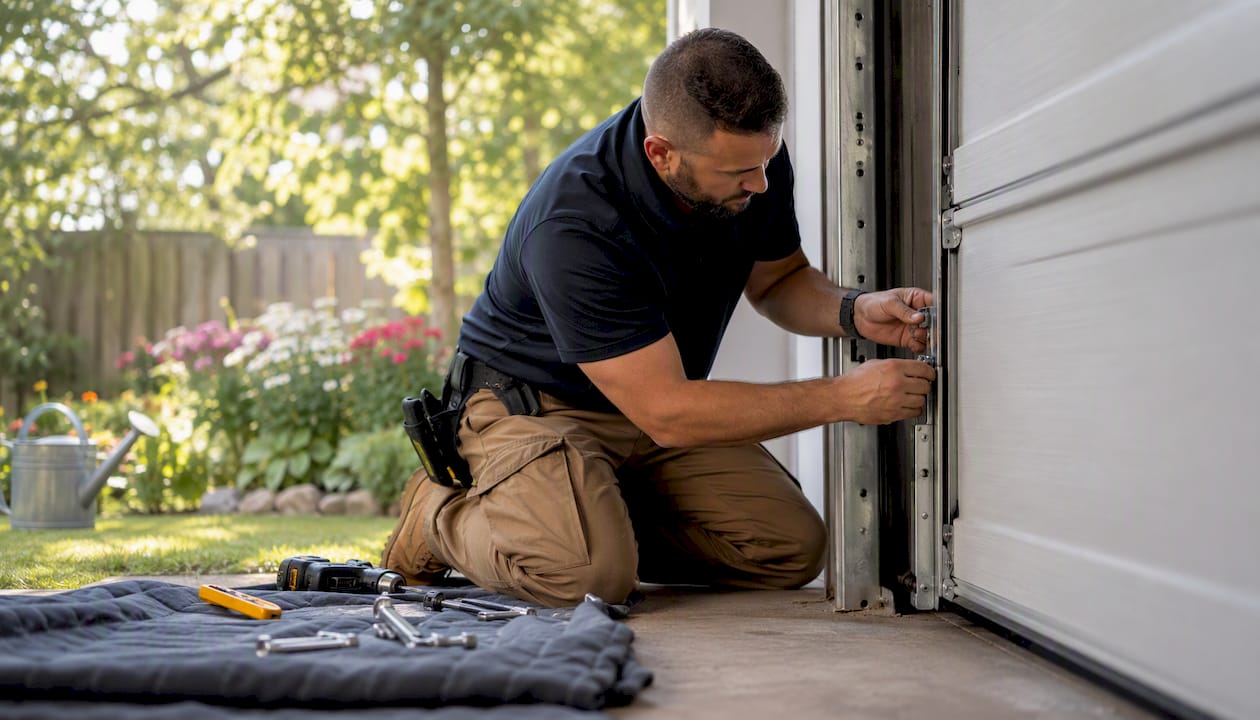
The first thing a technician does is run the door through a full cycle before touching anything. That single pass reveals more than a visual inspection: you can hear spring tension issues, see uneven travel, and catch sensor timing problems in real time. Most of the time, what a facility manager describes as a “door problem” turns out to be a counterbalance issue, a misaligned track section, or a sensor that’s drifted out of alignment from repeated forklift vibration.
Quick repairs — roller replacement, sensor realignment, lubrication, minor track adjustment — get resolved on the same visit. Spring replacement takes longer but is still typically a same-day job when the technician arrives with the right spring size. What forces a return visit is major track damage from a direct forklift strike, or an opener motor that’s failed from running an overloaded door for too long.
Mikes Garage Doors Loveland Colorado completes about 90% of repairs the same day, provides transparent estimates over the phone before the visit, and backs the work with warranties. Veterans receive a 10% discount. For a Northern Colorado facility that can’t afford a bay sitting idle, that response model matters.
Fast, honest commercial door service in Northern Colorado
When a bay goes down, you need a technician who shows up the same day and tells you the cost before they start. Mikes Garage Doors Loveland Colorado handles commercial dock door repairs, spring replacement, opener service, and preventive maintenance for facilities across Northern Colorado. Transparent phone estimates mean no surprises on the invoice. Same-day service on 90% of repairs means your bay gets back online fast. Veterans receive a 10% discount on all services.
Ready to schedule a service visit or get a phone estimate? Check out the full range of commercial door services and book a time that works for your operation.
Useful sources
- OSHA dock door safety requirements and penalties — fall protection rules, interlock requirements, and common citation triggers
- ISHN: Loading dock safety reassessment under OSHA’s warehouse emphasis program — auto-reverse timing expectations and cycle-life guidance
- DASMA Technical Data Sheet TDS-182: Technical Considerations for Dock Doors — authoritative specification guidance on door types, thermal performance, and system integration
- Loading Dock Doors: A Facility Manager’s Guide — practical overview of door selection and energy impact
- Mikes garage doors Loveland colorado: Commercial Door Services — local repair, maintenance, and emergency response for Northern Colorado facilities
- Commercial garage door maintenance schedule guide — inspection cadence and PM program planning
FAQ
What does a commercial dock door do?
A commercial dock door controls truck-level access, seals the building against energy loss, and provides the safety barrier that prevents falls at open dock openings. All three functions affect throughput, energy cost, and OSHA compliance.
How often should dock door safety sensors be tested?
Test photo-eye sensors and pressure-sensitive edges at least monthly, and log the results. Industry guidance requires auto-reverse to trigger within 2 seconds of resistance; any door that exceeds that threshold should be taken out of service until repaired.
What is the best dock door type for a cold storage facility?
High-speed insulated doors or insulated sectional doors are the standard choice for cold storage. Properly specified insulated doors can reduce energy loss by 20–30% in dock exchange scenarios, and high-speed models minimize air exchange during each cycle.
When is a dock door problem an emergency?
Uncontrolled descent, a broken torsion spring, failed auto-reverse, or severe track misalignment all require immediate action: lock out the opener, clear the bay, and call a technician. Mikes Garage Doors Loveland Colorado resolves most commercial emergencies the same day.
How long do commercial dock door springs last?
Spring lifespan depends on cycle count and the spring’s rated capacity. A high-cycle dock running hundreds of cycles daily needs springs rated for 100,000 cycles or more. Operating beyond that rating accelerates fatigue and risks uncontrolled descent, which is why logging cycles against the door’s rated capacity is a core part of any PM program.
Recommended
Need a hand with your door?
Talk to a real tech — most calls are diagnosed in under two minutes.