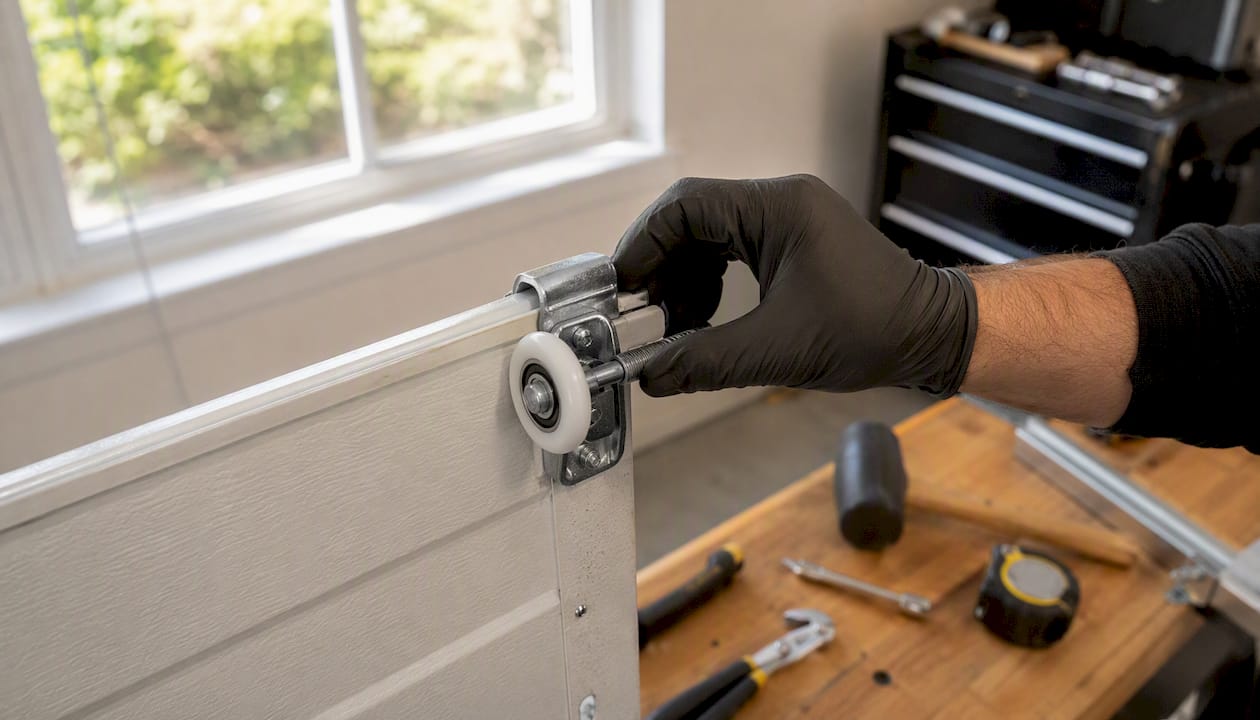
What Garage Door Rollers Actually Do for Your Door
Garage door rollers guide and bear your door’s full weight along the track, which is what lets a 150 to 400-pound door glide open and closed instead of grinding, sticking, or jumping the rail. When rollers wear out, you get noise first, then misalignment, then a door that can jump the track entirely. Here’s the short version: inspect rollers regularly, keep them lubricated, and replace them before they fail rather than after. Worn nylon rollers on standard bushings are worth upgrading to sealed 6200-bearing rollers when you replace them.
What to do right now:
- Listen for a grinding or clicking sound when the door moves.
- Look at each roller for chips, flat spots, or a wheel that leans instead of sitting straight.
- If the door is jerky, off-track, or won’t stay open, stop using it and call a professional.
Pro Tip: Run your door manually (opener disconnected) and watch the rollers at the curve where the track bends. That’s where wear shows up first, and it’s the easiest place to catch a problem before it gets loud or dangerous.
Key Takeaways
Garage door rollers bear the door’s full weight and guide it along the track, and replacing worn rollers before they fail prevents off-track incidents and opener damage.
| Point | Details |
|---|---|
| Rollers carry the load | They bear vertical door weight and lateral force at the track curve on every cycle. |
| Top rollers wear first | They cross the radius section on each cycle, so inspect them before the bottom rollers. |
| Skip WD-40 | Use silicone spray or white lithium grease; WD-40 strips factory grease and attracts dirt. |
| Sealed 6200 bearings last longer | They resist dirt and moisture, making them a near one-time upgrade for busy doors. |
| Mikes Garage Doors Loveland Colorado handles it same-day | Technicians match roller spec, check track alignment, and calibrate the opener in one visit. |
Where to Learn More About Garage Door Roller Care
- Doors covers general inspection and lubrication best practices.
- Clopay Door offers manufacturer-backed lubricant guidance.
- LearnGarageDoors provides a deeper dive into roller mechanics and replacement.
- DASMA addresses common hardware myths and material facts.
Table of Contents
- How Do Garage Door Rollers Work?
- Types of Garage Door Rollers: Nylon vs. Steel vs. Sealed Bearing
- How Do You Know If Your Garage Door Rollers Are Bad?
- How Often Should You Lubricate Garage Door Rollers?
- When Should You Replace Garage Door Rollers?
- How Much Does Garage Door Roller Replacement Cost?
- Choosing Replacement Rollers: What to Measure First
- When Should You Call a Professional for Roller Issues?
- Same-Day Roller Replacement in Loveland, Colorado
- Sources
- FAQ
How Do Garage Door Rollers Work?
Each roller is a simple assembly: a wheel, a bearing or bushing inside that wheel, a stem that connects it to the door panel, and a bracket that holds the whole thing in place. The wheel rides inside the steel track, the bearing lets the wheel spin with minimal resistance, and the bracket keeps everything aligned as the door travels vertically and then curves onto the horizontal ceiling track.
Rollers carry two kinds of load at once: the vertical weight of the door panel and the lateral force generated every time the door changes direction at the curve. That curve is why top rollers wear out faster than the ones lower on the door. They travel across the radius section on every single cycle, while bottom rollers mostly stay on the straight vertical run.
Bearing type determines how much friction reaches your opener motor. A rough or corroded bearing forces the opener to work harder on every cycle, which shortens the motor’s life along with the roller’s. Rollers wear gradually, and that wear usually shows up first as a subtle increase in noise long before anything visibly breaks.
A roller in good shape should turn smoothly with light finger pressure and make almost no sound as the door passes overhead. If it catches, grinds, or wobbles on the stem, that’s your early warning.
Pro Tip: During a manual lift test, put two fingers near (not on) a top roller as the door passes. Smooth rotation with a faint whir is normal. Anything that hesitates, clicks, or wobbles side to side means that roller is on its way out.
Types of Garage Door Rollers: Nylon vs. Steel vs. Sealed Bearing
Material and bearing design are the two variables that decide how loud, durable, and low-maintenance your rollers will be; for more details on door types and hardware considerations, see What Kind Of Doors Are Best For Interiors?. Most residential doors use one of three setups: steel rollers on open bearings, nylon rollers on standard bushings, or premium nylon rollers on sealed ball bearings.
Steel rollers are cheap and tough against heavy loads, but they’re also the noisiest option and tend to need more frequent lubrication because their bearings sit exposed to dust and moisture. Nylon rollers run quieter, resist rust since there’s no bare metal touching the track, and hold up well for most residential doors. Where nylon really pulls ahead is with sealed 6200-series ball bearings, which keep dirt and moisture out of the bearing race entirely and are rated for far more open-and-close cycles than a basic bushing roller.
| Roller Type | Bearing Design | Noise Level | Typical Lifespan | Maintenance Needs |
|---|---|---|---|---|
| Steel, open bearing | Open ball bearing | Loud | Shorter under regular use | Frequent lubrication |
| Standard nylon | Bushing | Quiet | Moderate | Occasional lubrication |
| Premium nylon, sealed | Sealed 6200 ball bearing | Very quiet | Long, high cycle rating | Minimal |
Before buying replacements, check four things: wheel diameter, stem length and diameter, whether your track is 2 inches or 3 inches wide, and whether you want a sealed or open bearing. Some industry writeups push back on the myth that plastic or nylon rollers are inherently weak. In practice, a quality sealed nylon roller often outlasts a cheap steel one.
Pro Tip: If your door only gets a handful of cycles a day, standard nylon is plenty. If you’re opening and closing multiple times daily, or the door is oversized, the sealed 6200 bearing upgrade pays for itself in fewer service calls.
How Do You Know If Your Garage Door Rollers Are Bad?
Roller failure rarely happens overnight. It builds gradually across three categories of warning signs, and catching them early is what separates a $15 roller swap from a $400 emergency call.
Audible cues come first. A clicking sound usually means a chipped wheel hitting the track seam on every rotation. Grinding points to a dry or damaged bearing. A rhythmic rumble that sounds almost like a train car crossing a rail joint often means multiple rollers are worn at once.
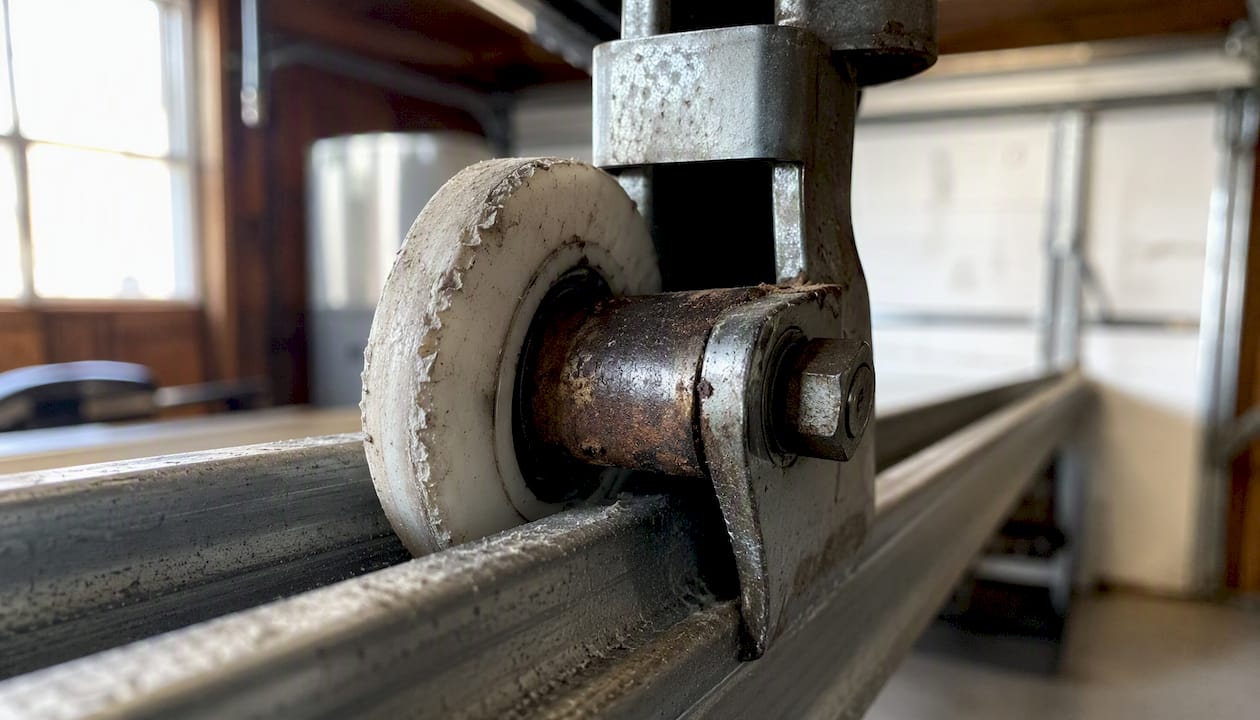
Visual cues confirm what you’re hearing. Look for flat spots on the wheel, visible chips or cracks in nylon rollers, a stem that leans instead of sitting perpendicular to the bracket, rust buildup on steel rollers, or a bearing that simply doesn’t spin when you nudge it by hand.
Performance cues show up in how the door moves. Jerky or hesitant travel, a door that visibly sits off-track, or an opener that needs a higher force setting than it used to are all signs rollers are struggling.
If you’re calling a technician, snap photos of any leaning stems, chipped wheels, and the track section where the wear is worst. It cuts diagnostic time down significantly. Our full checklist on repair warning signs covers related red flags worth ruling out at the same time.
Pro Tip: A single bad roller rarely stays a single problem for long. If one roller is chipped, check its neighbors on the same side. Uneven wear on one side of the door often means the whole run needs attention.
How Often Should You Lubricate Garage Door Rollers?
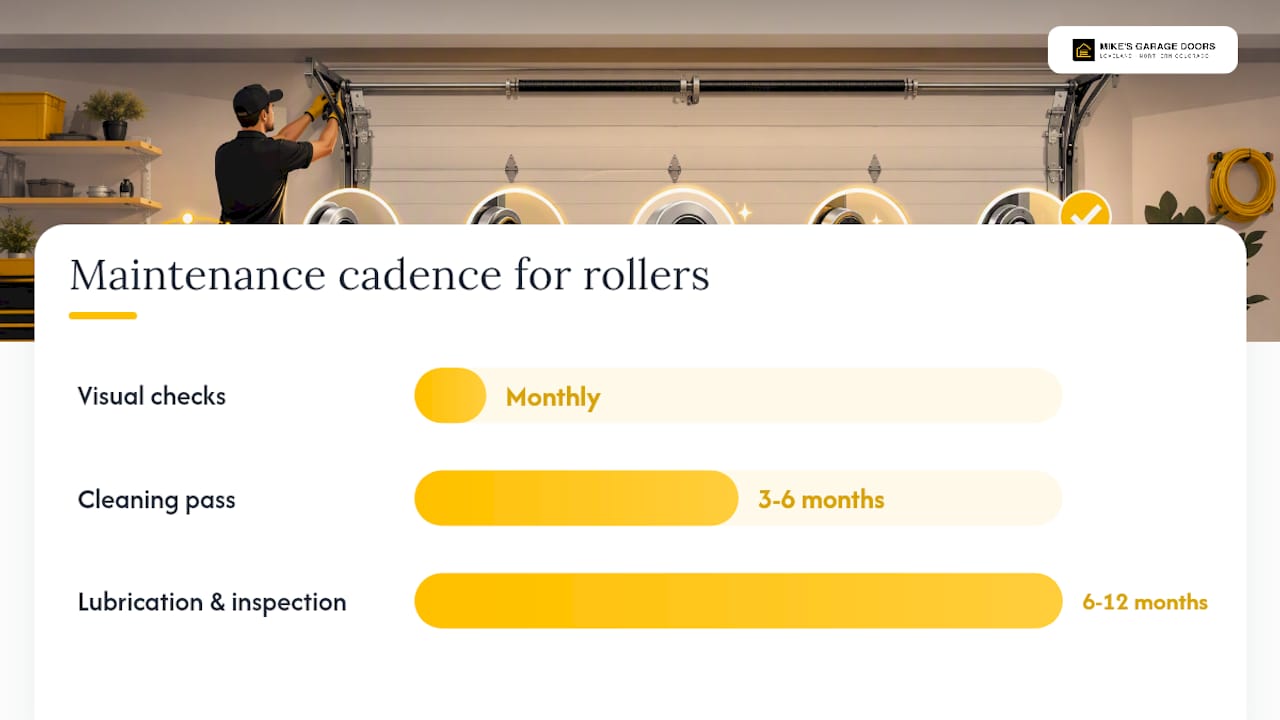
A simple maintenance routine catches most roller problems before they become expensive ones. Industry maintenance guidance recommends monthly visual checks, a cleaning pass every 3 to 6 months, and a full lubrication and inspection every 6 to 12 months, and following that cadence can extend the life of these components substantially.
Here’s the routine, in order:
- Disconnect the opener and manually close the door before doing anything else.
- Wipe down the tracks and rollers with a dry cloth to clear dust, cobwebs, and old grease buildup.
- Inspect each roller for the audible, visual, and performance signs covered above.
- Apply lubricant to the bearings and stems, not the track surface itself.
- Cycle the door manually a few times to work the lubricant into the bearing.
On lubricant choice, skip anything you already have in the garage that says WD-40 on the label. Clopay’s manufacturer guidance is direct on this: WD-40 is a solvent and degreaser, not a lubricant, and it strips out the factory grease while attracting more dust. Use a silicone-based spray or white lithium grease instead.
Keep a small kit on hand: silicone spray or white lithium grease, a soft cloth, a flashlight for inspecting bearings, and work gloves. Doors backs the same approach, recommending visual inspection of springs, cables, rollers, and pulleys alongside light lubrication of moving parts.
When Should You Replace Garage Door Rollers?
Replace rollers when you spot visible cracks or chips, a bearing that grinds or won’t spin, a stem that leans more than a few degrees, or after any incident where the door has jumped the track. If you’re already having springs replaced, replace the rollers at the same time. A worn roller puts extra strain on the new spring and opener, shortening their life too.
For homeowners comfortable with basic tools, here’s the safe sequence a technician follows:
- Disconnect the opener and unplug it.
- Clamp the door securely in the open or closed position so it can’t shift.
- Remove the roller bracket carefully, supporting the panel as you go.
- Slide out the old roller and insert the replacement, matching bearing spec.
- Reattach the bracket and test the door manually before reconnecting power.
- Lubricate the new rollers and cycle the door several times to check smooth travel.
Two things to never touch yourself: torsion springs and any roller replacement while the door is under spring tension. Springs store enormous energy, and a mistake here causes serious injury. If you’re not fully confident clamping the door safely or the door is under tension you can’t release, stop and call a professional.
Most technicians recommend replacing all rollers together rather than one at a time. Matching bearing spec across every roller keeps wear even and noise consistent, and it saves you a repeat service call in six months when the next roller fails.
How Much Does Garage Door Roller Replacement Cost?
Roller pricing depends mainly on material and bearing type. Builder-grade steel rollers sit at the low end, standard nylon rollers cost a bit more, and premium sealed 6200-bearing rollers command the highest price per unit, though they’re a one-time upgrade for most residential doors given their high cycle-life ratings.
Labor time varies with door size and access. A single-car door typically takes less time than a two-car door, and jobs often run longer when track cleaning or hinge replacement gets bundled in.
| Cost Factor | Impact on Price |
|---|---|
| Roller material and bearing type | Steel and standard nylon cost less than sealed 6200-bearing rollers |
| Door size | Two-car doors need more rollers and more labor time than single doors |
| Access complexity | Tight garages or high ceilings add time |
| Bundled services | Track cleaning or hinge swaps done at the same visit add to the total |
Our detailed roller cost breakdown walks through specific pricing scenarios if you want exact numbers for your door type.
Choosing Replacement Rollers: What to Measure First
Getting the spec wrong is the most common DIY mistake. Before you order anything, measure the stem diameter and length, the wheel diameter, and confirm whether your track is 2 inches or 3 inches wide, since a roller sized for one won’t ride correctly in the other.
Check bearing type next. If your current rollers use an open bearing or bushing, you can typically upgrade to sealed 6200 bearings during replacement, which is worth doing if your door cycles often or you want quieter operation for years without touching it again.
- Stem diameter and length (measure against your existing roller).
- Wheel diameter and track width (2-inch vs. 3-inch).
- Bearing type: open, bushing, or sealed 6200.
- Door type: standard sectional doors use different rollers than roll-up or coiling doors, which sometimes need specialty hardware.
Pro Tip: Bring your old roller to the hardware store or send a clear photo to your technician. Matching stem size exactly avoids a return trip.
When Should You Call a Professional for Roller Issues?
Some situations call for a professional, full stop. A door that’s visibly off-track, a broken spring, frayed cables, a severely bent or leaning roller stem, or a door that won’t stay open on its own all fall into that category. Any of these can turn a simple fix into a safety hazard fast.
A technician handling roller service typically runs a full diagnostic, replaces worn rollers, checks and adjusts track alignment, inspects springs and cables, calibrates the opener’s force setting, and runs a safety test before leaving. Bundling roller replacement with a spring or diagnostic inspection visit saves you both time and a second service fee.
Pro Tip: If your opener has been straining or reversing unexpectedly, get rollers checked before you replace the opener. A worn roller is often the real cause, not the motor.
A Maintenance-First View on Garage Door Rollers
Most garage door emergencies I see traced back to something that made noise for weeks first. Rollers rarely fail without warning. They tell you they’re going, and homeowners who act on that early clicking sound almost always spend less than the ones who wait for the door to jump the track.
Same-Day Roller Replacement in Loveland, Colorado
If the manual lift test left you unsure, or you’d rather not disconnect the opener yourself, Mikes Garage Doors Loveland Colorado gets a technician to your driveway the same day for a straightforward roller inspection and replacement, no guesswork over the phone estimate.

Our techs carry sealed 6200-bearing rollers on the truck alongside standard nylon options, so whichever spec your door needs gets matched on the spot rather than ordered and scheduled twice. A roller visit is also the efficient time to get track alignment checked and the opener’s force setting recalibrated, since a worn roller often throws both off without you noticing. Head to our garage door services page to see the full scope of what we handle, or call to get a same-day appointment on the books.
Sources
- Doors
- How to Maintain Your Garage Door Rollers | Kraus Garage
- DURA-LIFT dura-lift 2 nylon garage door rollers (6200ZZ sealed) | Dura-Lift hardware
- The complete guide to garage door rollers | LearnGarageDoors
FAQ
How do you know if your garage door rollers are bad?
Listen for clicking or grinding, look for chipped wheels or leaning stems, and watch for jerky door movement. Any of these signals it’s time for a closer inspection or replacement.
How much does garage door roller replacement cost?
Pricing depends on roller material, bearing type, and door size, with sealed 6200-bearing rollers costing more upfront than standard steel or nylon. Our roller cost guide breaks down specific price ranges.
What happens if rollers aren’t replaced?
Worn rollers get louder, strain the opener motor, and eventually cause the door to jerk, misalign, or come off the track entirely, which can turn into a much larger repair.
Is it necessary to replace garage door rollers?
Yes, once rollers show chips, grinding, or leaning stems, replacement is necessary. Delaying it risks the door jumping the track and damaging the opener or springs in the process.
Can I lubricate garage door rollers myself?
Yes. Disconnect the opener, wipe down the rollers and tracks, and apply silicone spray or white lithium grease to the bearings, never WD-40, following a schedule of roughly every 6 to 12 months.
Recommended
Need a hand with your door?
Talk to a real tech — most calls are diagnosed in under two minutes.


