
5 Minute Safe Checklist for Homeowners: Humming Garage Door Opener
A humming garage door opener usually means one of two things: the motor has power but can’t turn, or it’s straining against a door that’s stuck, off track, or too heavy to lift. Pull the emergency release cord and try lifting the door by hand right now. If it’s heavy or won’t budge, the door is the problem. If it lifts smoothly, the opener is.
TL;DR:
- A humming garage door opener often indicates a failed start capacitor, a broken drive gear, or an electrical fault rather than a mechanical door issue.
- Visual clues like bulging capacitors, shavings from a stripped gear, or a loose sprocket help identify specific failures.
- Most repairs can be safely attempted by homeowners, except for torsion spring adjustments and handling live electrical components, which require professional skills.
- Faults caused by heat or cold may worsen over time, with heat degrading capacitors and cold tightening components, so environmental conditions matter.
- Calling a technician promptly is advised when the door is heavy, the motor smells burnt, or the motor runs hot without moving the door, especially if internal components show visible damage.
Table of Contents
- What’s Causing Your Garage Door Opener Humming Problem?
- Common Causes Behind a Humming Garage Door Motor
- Safe DIY Checks (and What to Leave Alone)
- When to Call a Garage Door Technician
- Our Take: When DIY Makes Sense and When It Doesn’t
- Get Your Opener Fixed Today
- Sources
- FAQ
What’s Causing Your Garage Door Opener Humming Problem?
Run this checklist before you touch anything else. It takes about five minutes and tells you exactly where the fault lives.
- Stop pressing the button. Repeated attempts can overheat and burn out the motor winding. Unplug the opener if you suspect an electrical fault.
- Pull the red emergency release hanging from the trolley and lift the door by hand. Heavy or immovable means a spring or balance issue. Light and smooth means the opener itself is failing.
- Look for visual clues: Is the manual lock engaged? Is a panel off its track? Is there chain or belt slack, or plastic shavings scattered under the motor unit?
- Feel the vibration. A strong shake with no movement points to a jammed gear or slipping sprocket. A faint, steady hum usually points to a capacitor.
- Check the power supply. Confirm the outlet and GFCI are live, then watch the opener’s diagnostic LED. Most brands flash a specific pattern that identifies the fault, so count the blinks and jot down the pattern.
Pro Tip: Keep your phone handy and film the hum for 15 seconds. If you end up calling a technician, that clip tells them more in five seconds than a phone description ever will.
Common Causes Behind a Humming Garage Door Motor
Most humming complaints trace back to one of two families: the opener can’t start turning, or the door won’t let it. Here’s how to tell them apart by sound and sight.
- Failed start/run capacitor. This is the textbook cause of a humming opener that won’t move. The motor hums steadily and never catches. Pop the cover (unplugged, always) and look for a small cylindrical part that’s bulging, leaking, or discolored. If you nudge the door and the motor suddenly spins, that’s a near-certain capacitor confirmation.
- Stripped nylon drive gear. The motor spins fine, but the chain or belt never moves because the internal gear has worn down to plastic dust. Shavings collecting under the motor housing are the giveaway. This part wears out from age and use, not from a single event, so it’s common in openers older than 10 to 12 years.
- Slipping sprocket. A loose set screw lets the sprocket spin freely on the motor shaft. The motor runs, the chain jerks or crawls instead of moving cleanly, and you’ll sometimes hear a rhythmic clunk layered under the hum.
- Chain or belt off the sprocket, or snapped. Look at the rail. Slack chain pooling near the motor head, or a belt that’s come loose from its track, means the trolley simply has nothing to pull it. The motor runs at full hum with zero resistance.
- Burned-out or seized motor. A hum paired with a burning smell or a hot housing means the windings themselves have failed. This almost always means replacing the powerhead rather than a part inside it.
- Broken torsion spring or off-track door. If lifting by hand felt like moving a car, a spring has likely snapped, or the door has jumped its track. Check the spring above the door for a visible gap in the coil, and check that the door sits square in its tracks rather than tilted.
- Manual lock or jammed track. The simplest cause on this list. Check whether the inside manual lock lever is engaged, and clear the track of any obstruction before assuming anything mechanical has failed.
A humming opener while it’s just sitting idle, with nobody touching the remote, is its own red flag. That’s not a normal resting sound and often points to a stuck relay, a failing transformer, or a logic board fault inside the unit rather than anything mechanical on the door itself.
Climate plays a role you might not expect. Capacitors degrade faster in sustained heat, so a garage that bakes all summer will chew through this part faster than a shaded or insulated one. Cold weather has its own effect, stiffening chain lubricant and tightening door seals just enough to load extra resistance onto an aging motor. If your humming problem started right after a heat wave or a cold snap, that timing itself is a clue.
Safe DIY Checks (and What to Leave Alone)
Some of this you can safely handle yourself. Some of it can genuinely hurt you. Here’s the line.
- Unplug the opener before removing any cover. Never work on a powered unit, and never assume a capacitor is safe just because the opener is unplugged. Charged capacitors can hold voltage after power is cut, so if you weren’t trained to discharge one, don’t touch the terminals.
- Test your outlet and GFCI first. A tripped GFCI is a five-second fix that gets mistaken for a motor failure constantly.
- Check and reset the photo-eye sensors. Wipe the lenses, confirm they’re aligned, and make sure both LEDs glow steady rather than blinking.
- Tighten a loose sprocket set screw if it’s easily accessible with an Allen wrench, and reseat a slipped chain onto its sprocket only if you understand the tensioning mechanism on your specific model.
- Replace the capacitor yourself only if you’re an experienced hobbyist with insulated tools, you know how to discharge it safely, and you match the exact microfarad and voltage rating of the original part. If any of that sounds unfamiliar, this is not the project to learn on.
Never attempt torsion spring repair yourself. These springs hold enough tension to snap a bone or worse, and there’s no safe amateur shortcut around that. If you want to understand why professionals treat spring tension adjustment as specialized work, that’s the reason.
Grab insulated gloves, safety glasses, a stable step ladder, and an insulated screwdriver before opening any cover.
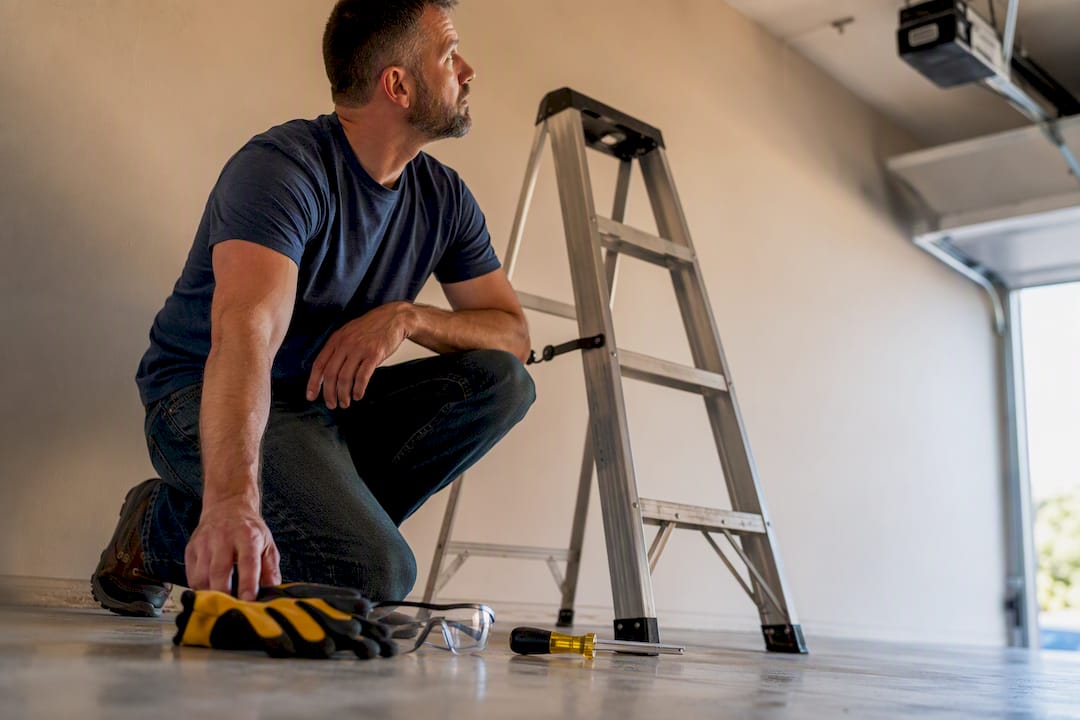
Pro Tip: Photograph the capacitor, the gear housing, and any shavings before you close everything back up. A technician can often confirm the diagnosis from those photos alone, sometimes before they even arrive.
When to Call a Garage Door Technician
Some symptoms mean stop troubleshooting and pick up the phone. Others just mean the fix is beyond a basic toolkit.
- The door is heavy or won’t budge by hand, which points to a broken spring.
- You see a visible gap in a spring coil, or the door sits crooked on its tracks.
- There’s a burning smell, visible heat, or the motor housing is hot to the touch.
- The breaker keeps tripping every time you try the opener.
- A capacitor looks bulged, swollen, or has leaked fluid.
- The motor hums at full strength with zero movement despite the chain, belt, and gears all looking intact.
Related reading on warning signs your garage door needs repair now covers several of these in more depth, and it’s worth a look before your appointment. Prolonged stalling under load also risks overheating the motor windings, so don’t keep testing a hum that isn’t going anywhere.
When you call, have these ready: your opener’s brand and model number, whether the door lifts easily by hand, a description of the sound (steady hum, clicking, grinding), anything visible (shavings, a spring gap), and the LED flash pattern if your unit has one. Expect a diagnostic visit, an upfront estimate before work begins, and a good chance of a same-day fix if the part, like a capacitor or gear kit, is something the technician carries on the truck.
Our Take: When DIY Makes Sense and When It Doesn’t
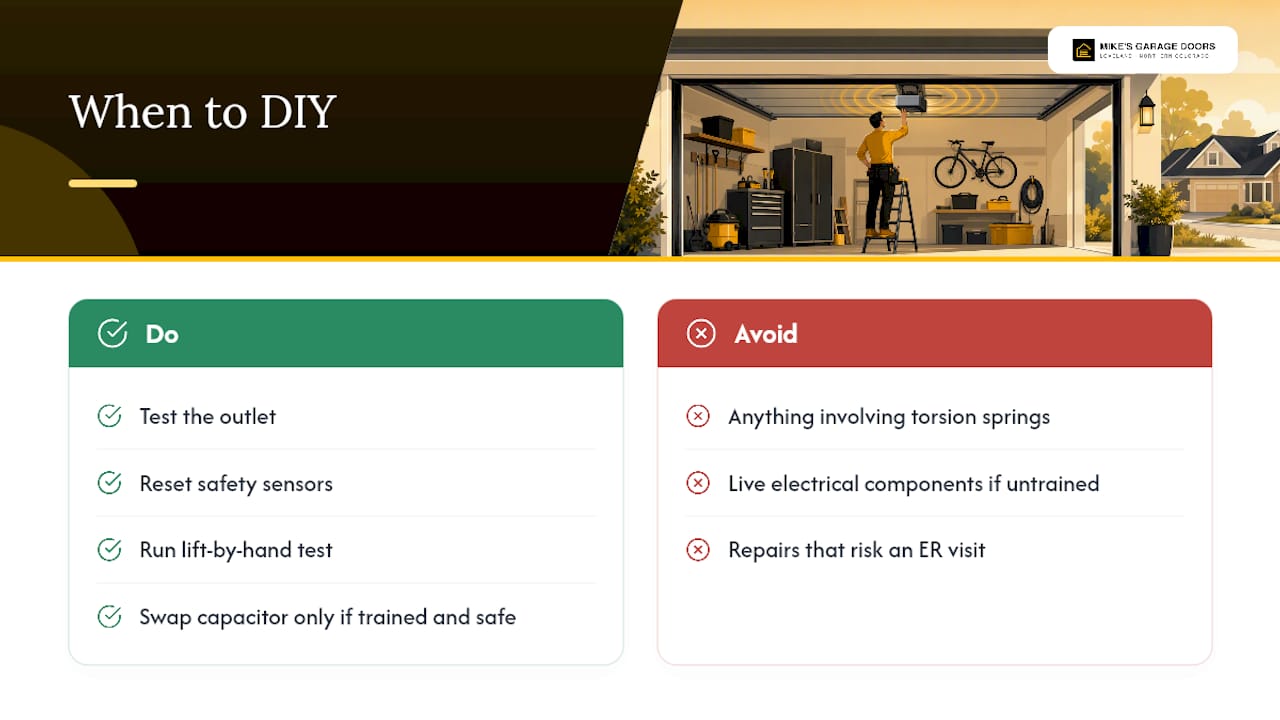
Most of the checklist above is worth doing yourself. Testing the outlet, resetting sensors, running the lift-by-hand test, even swapping a capacitor if you’ve got the right tools and know how to discharge one safely, these save you a diagnostic fee and a day of waiting. Where we draw a hard line is anything involving torsion springs or live electrical components you’re not trained on. That’s not caution for caution’s sake. That’s where a $200 repair turns into an ER visit.
That’s the whole point of running the checklist first.
— Eddie
Get Your Opener Fixed Today
Mike’s Garage Door Repair gets most callers back in business the same day, not because we rush, but because our trucks already carry the capacitors, gear kits, and rollers that fix the vast majority of humming complaints on the first visit. You get a transparent, upfront estimate over the phone before anyone shows up, so there’s no surprise invoice waiting at the end.

If your triage points to a capacitor, a stripped gear, or a spring that’s clearly done, skip the guesswork and let a technician confirm it in person. Explore our full lineup of garage door services in Loveland, including opener repair, spring replacement, and emergency calls, and get a same-day estimate before the hum turns into a dead motor.
Sources
- Garage Door Opener Hums But Won’t Move? Causes & Fixes — Farnsworth Garage
- Genie Opener Hums but Won’t Move? Start Capacitor Fix — Trunetto
- Garage Door Opener Buzzing? Causes & Safety Risks — BCS Overhead Door
FAQ
My garage door opener hums but the door doesn’t move. What’s wrong?
It’s almost always a failed start/run capacitor, a stripped drive gear, or a door too heavy to lift because of a broken spring. Pull the release cord and lift by hand to tell which family it’s in.
What are the symptoms of a bad capacitor on a garage door opener?
A steady hum with no motor start, and sometimes a visibly bulged or leaking cylindrical part inside the motor cover. The motor may briefly spin if you give the door a gentle push while it’s humming.
Why does my garage door opener buzz when I’m not using it?
Buzzing while idle usually signals an internal electrical fault, like a stuck relay, failing transformer, or logic board issue, rather than anything mechanical on the door. It’s not a normal sound and shouldn’t be ignored.
Why is there a buzzing sound in my garage that isn’t the opener?
Check for a failing transformer on a nearby appliance, a loose electrical connection, or vibration from an HVAC unit. If the sound tracks with the opener’s power state, it’s the opener, not something else in the room.
Can I fix a humming garage door opener myself?
Basic checks, sensor resets, outlet testing, tightening an accessible set screw, are safe DIY territory. Capacitor and spring work carry real electrical and physical risk, and that’s when Mike’s Garage Door Repair should take over.
Recommended
Need a hand with your door?
Talk to a real tech — most calls are diagnosed in under two minutes.


